
Bookshelf Decor Ideas That Reflect Your Life, Not Just Your Style
A bookshelf is one of the only surfaces in a home that’s actually supposed to tell people who lives there. Most end up either bare or crammed — rarely because of taste, but because nobody’s ever explained the actual mechanics of what makes a shelf read as designed instead of just full. Here’s the method, step by step.
Start With Fewer Objects Than You Think
Almost everyone overfills a shelf on the first pass, because the instinct is to use the space, not to edit it. Pull everything off, then put back roughly half of what you’re tempted to include — the pieces that lose ground first are usually the ones that don’t say much about anyone in particular. A shelf with room to breathe reads as curated. A shelf with no gaps reads as storage, no matter how nice the objects are.
Build in Odd-Number Groupings
Groups of three or five read as arranged; groups of two or four read as a pair that happens to be sitting near each other. The reason is subtle but consistent: even numbers give the eye a way to split the group symmetrically and stop looking, while odd numbers force it to keep scanning until it settles on a center. That’s the same instinct that makes a triangle feel more dynamic than a straight line.
Vary Heights
A shelf where every object is roughly the same height reads as flat even if the objects themselves are interesting. Stack books to create risers, prop one object on top of another, and let at least one piece break well above the rest — height variation is what turns a row of items into a small skyline the eye can actually travel across.
Mix Books With Sculpture
Books alone tend to read as a library; objects alone tend to read as a display case. Mixing the two is what makes a shelf feel like a person’s actual space instead of a staged one — spines provide color and texture in bulk, while a sculptural object (a bowl, a bust, a specimen, anything with real form) gives the eye something dimensional to rest on between them.
Repeat One Accent Color
A single color reappearing across two or three objects — a ceramic, a book spine, a small frame — is what makes an otherwise random mix of collected things look intentional. Without a repeating thread, even beautifully chosen objects can read as unrelated. This is the same mechanism that holds a maximalist room together at a larger scale, just applied to a single shelf.
Add Natural Texture
Wood, stone, woven fiber, or a live plant breaks up the flatness of paper and painted surfaces, which otherwise dominate most shelves. Natural texture also ages well — it doesn’t read as trendy the way a lot of decorative objects can, which matters on a surface you’re not likely to restyle often.
Leave Negative Space
Empty space on a shelf isn’t a gap to be filled — it’s what gives the filled sections somewhere to be noticed against. A shelf with roughly a fifth of its area intentionally left open reads as more considered than one that’s fully packed, the same way a sentence with punctuation reads more clearly than one that runs on without pause.
Light the Shelves
Overhead room lighting flattens a shelf the same way it flattens a maximalist wall — a small integrated light strip, a plug-in puck light, or even a nearby table lamp angled toward the case gives depth and shadow to objects that otherwise disappear after dark. This step gets skipped constantly, and it’s often the single biggest gap between a shelf that photographs well and one that doesn’t.
Style by Shelf, Then Evaluate the Whole
Style one shelf at a time so each one has its own internal logic, then step back and look at the full case together — this is where most styling mistakes actually get caught. A shelf that looked balanced in isolation can suddenly compete with the one above or below it once you see them stacked. Adjacent shelves need to feel related, not identical, which usually means shifting where the height variation and color repeats land so they don’t stack in the same spot on every level.
Common Mistakes
The same handful of issues account for most shelves that don’t work:
- Everything the same height — no risers, no stacking, nothing breaking the line.
- No repeating color — every object pulling in a different direction with nothing tying them together.
- Books spine-out only, at uniform size — missing the chance to stack horizontally and create height variation for free.
- Zero negative space — the shelf reads as storage rather than a curated surface.
- Objects with no personal connection — generic décor filler bought specifically to fill the shelf, rather than things actually collected or meaningful.
What Gives a Shelf Soul
Every technique above is a mechanic — hierarchy, repetition, negative space, texture. None of them is what actually makes a shelf feel like yours. That comes from what you put on it. A shelf styled with someone else’s idea of “good taste” — objects bought specifically because they photograph well, with no connection to the person arranging them — can follow every rule above and still feel hollow. The shelves that stop people are the ones where a few pieces clearly meant something before they ever ended up on display: a rock from a specific trip, a chipped mug nobody would sell but nobody will throw away, a stack of field guides that are actually used. The method makes a shelf look designed. What you put in it is what makes it feel true.
One Bookcase, Five Identities
Same built-in, same dimensions, same lighting — five completely different people. This is the clearest way to see that “good shelf styling” was never really about a style category at all. It’s about whose interests are actually sitting on it.
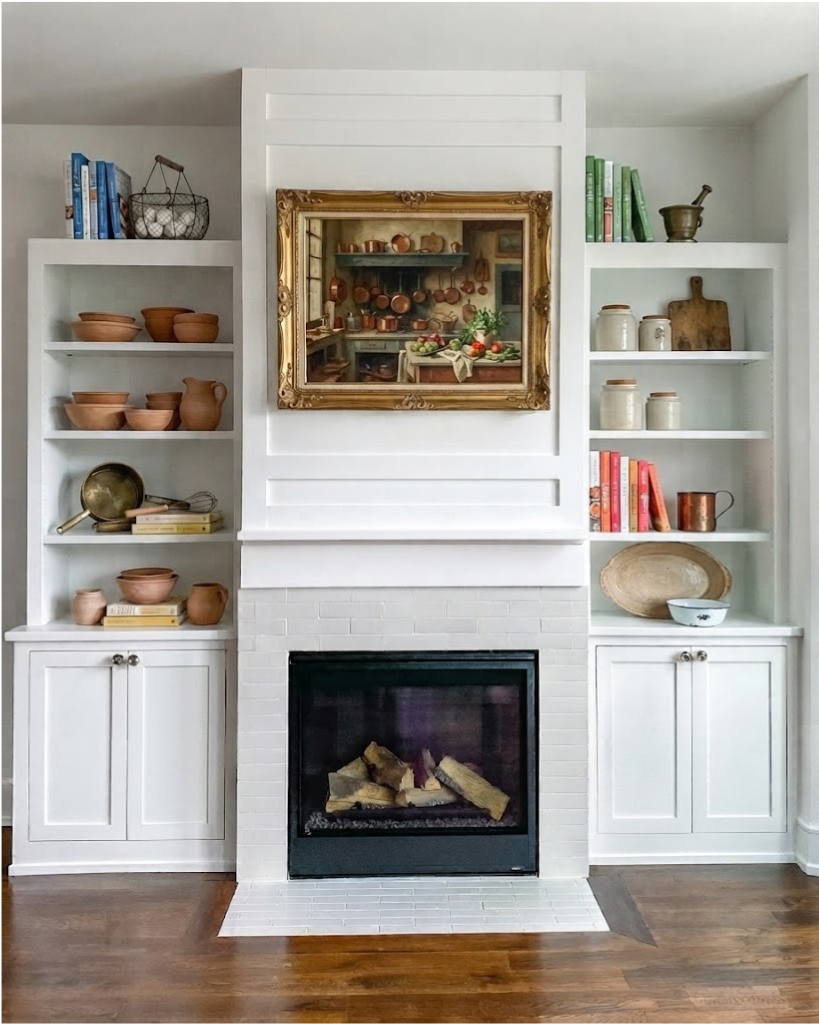
Cookbooks & Kitchen Curiosities
Stacked cookbooks by color, vintage kitchen tools, a few unglazed ceramics with real texture.
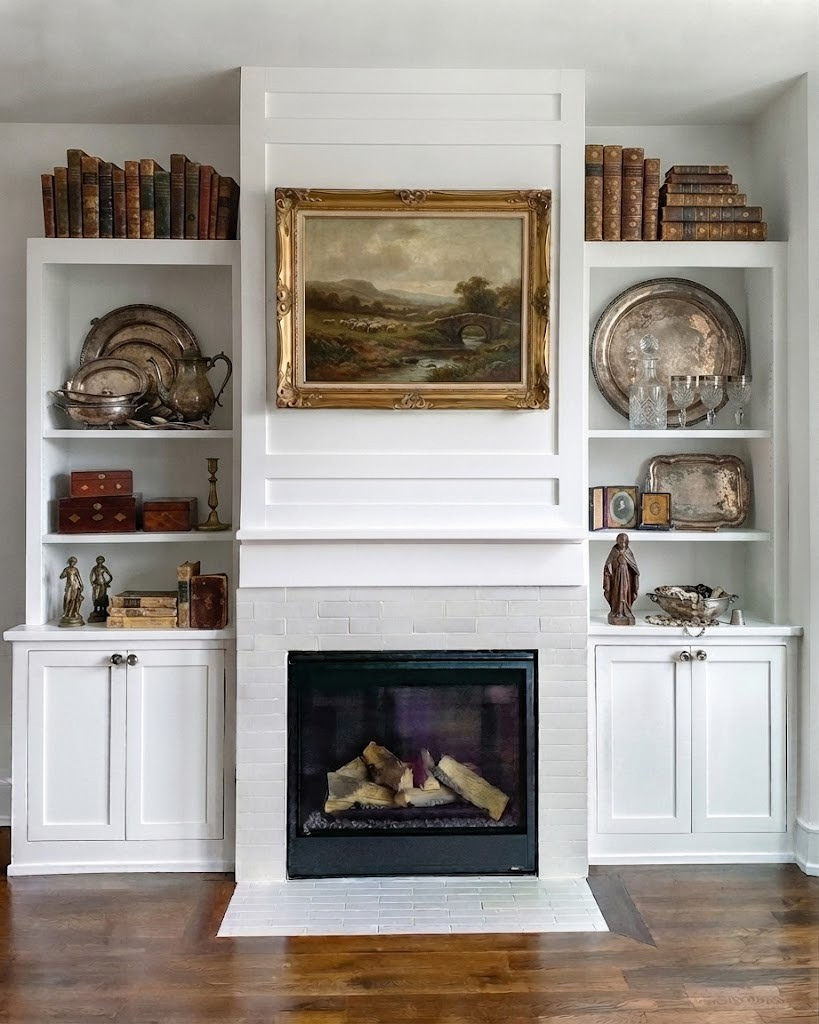
Antiques & Heirlooms
Inherited objects with visible age, leather-bound spines, silver with real patina left unpolished.
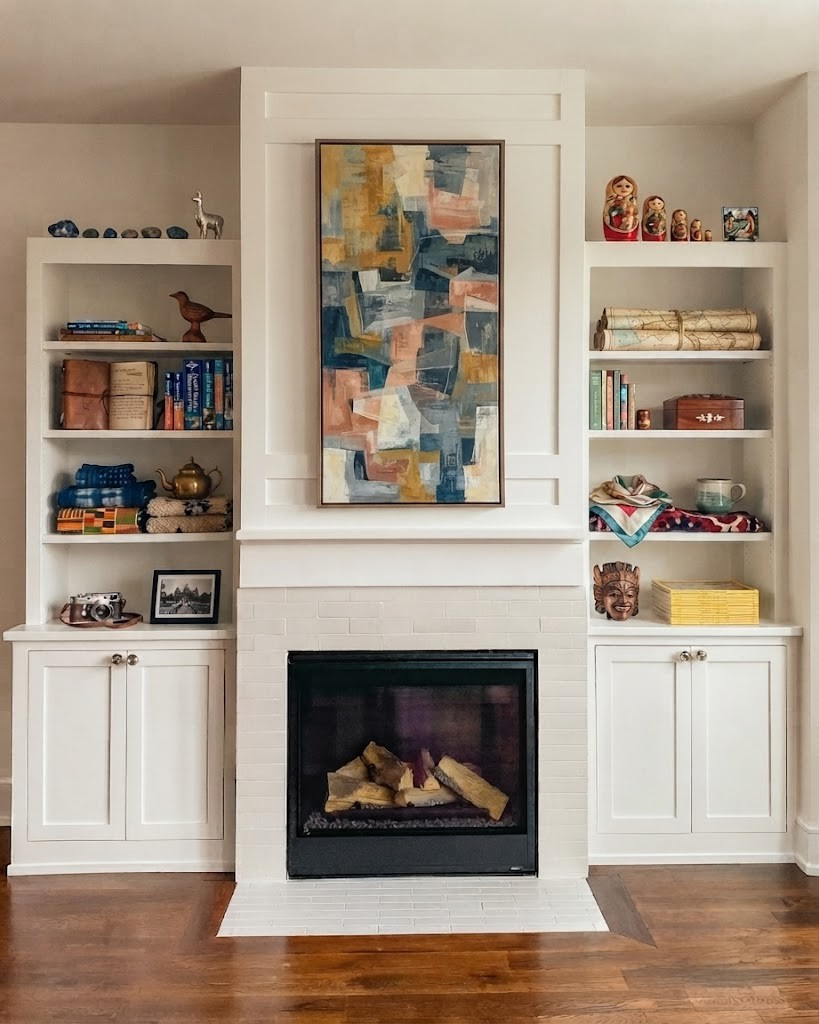
Travel Curios
Small objects collected from specific places, maps and travel guides, textiles that don’t match on purpose.
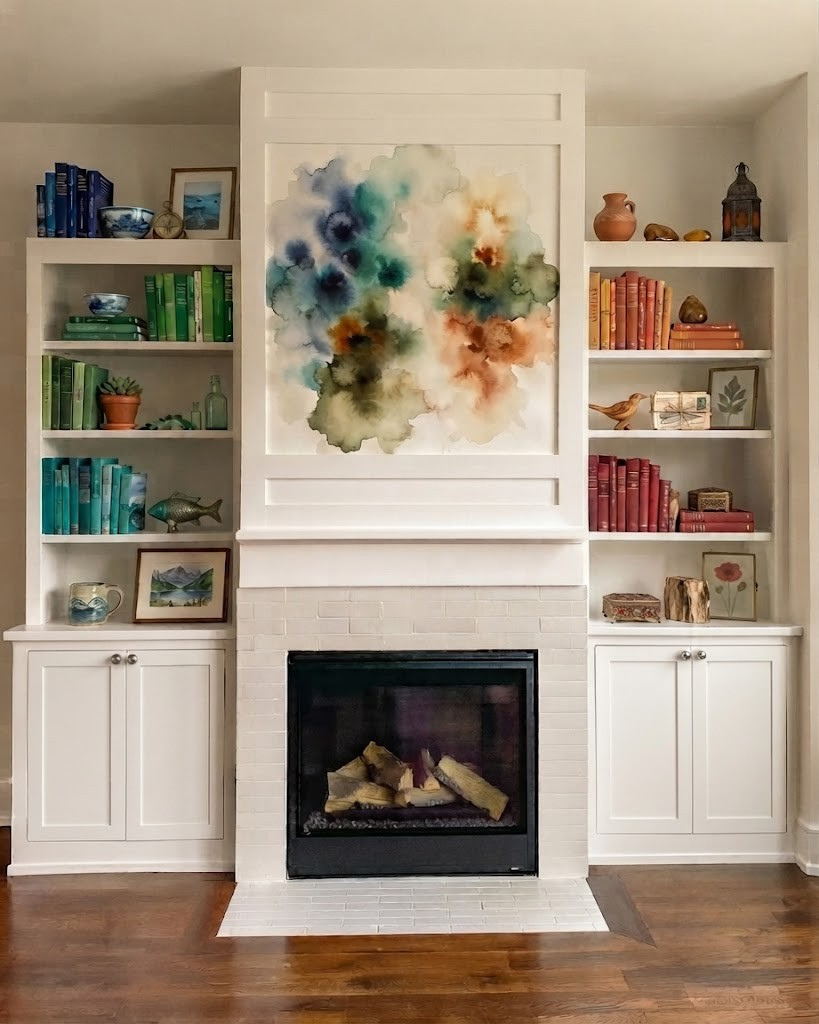
Color
For anyone building a collection from scratch — books and objects chosen and arranged purely by hue.
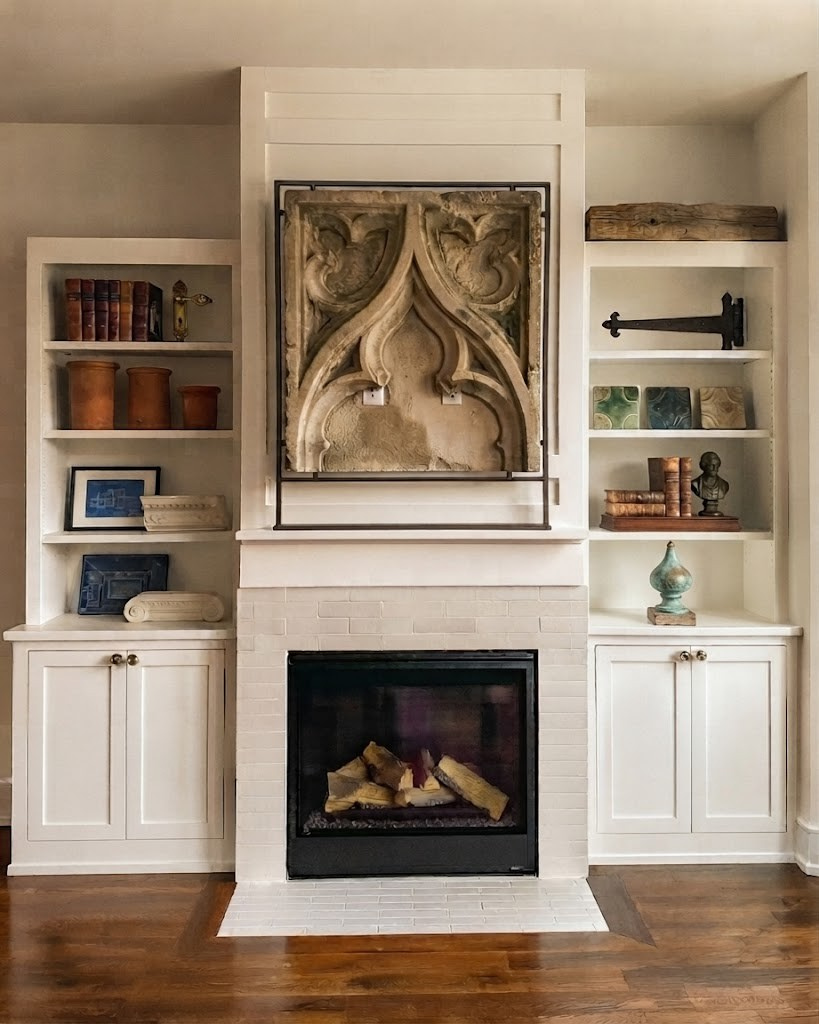
Architectural Artifacts
Salvaged hardware, corbels, fragments of molding, a drafting tool or two — objects with real structural history.
Not sure what belongs on your shelves? true designs your actual room — not a generic inspiration photo — and recommends real pieces that fit your style, your interests, and your budget.
Start your room — $95Frequently Asked Questions
How do you style a bookshelf like a designer?
Start with fewer objects than feels natural, group items in odd numbers, vary height and depth, mix books with sculptural objects, repeat one accent color throughout, add natural texture, and leave visible negative space. Style one shelf at a time, then step back and evaluate the whole case together.
How many objects should be on a styled bookshelf?
Fewer than most people assume — start with roughly half of what you’re tempted to place, then add back only pieces that earn their spot. Overfilling is the most common styling mistake.
What makes a bookshelf look designed instead of random?
A repeating accent color, varied object height, and visible negative space are what separate a styled shelf from a collection of stuff. Without those three, even good individual objects read as clutter.