
A Bigger Room Doesn’t Need More Furniture. It Needs Better Scale.
Most people assume that if a large room feels empty, the solution is to add more furniture.
It usually isn’t.
The real issue is that the furniture isn’t scaled to the architecture, and the room never develops visual anchors that make it feel complete. You can fill every square foot of a two-story great room and still walk in and feel like something’s missing. That feeling isn’t about quantity. It’s about relationship — the relationship between the pieces you’ve chosen and the volume of space they’re sitting in.
We see this constantly in great rooms like the one below: soaring ceilings, walls of glass, a staircase that doubles as sculpture. These rooms are dramatic by design. But drama in the architecture creates a job for the furniture, and if the furniture doesn’t show up for that job, the room reads as unfinished no matter how much is in it.
Here are two approaches to furnishing the exact same room.
Approach A and Approach B.
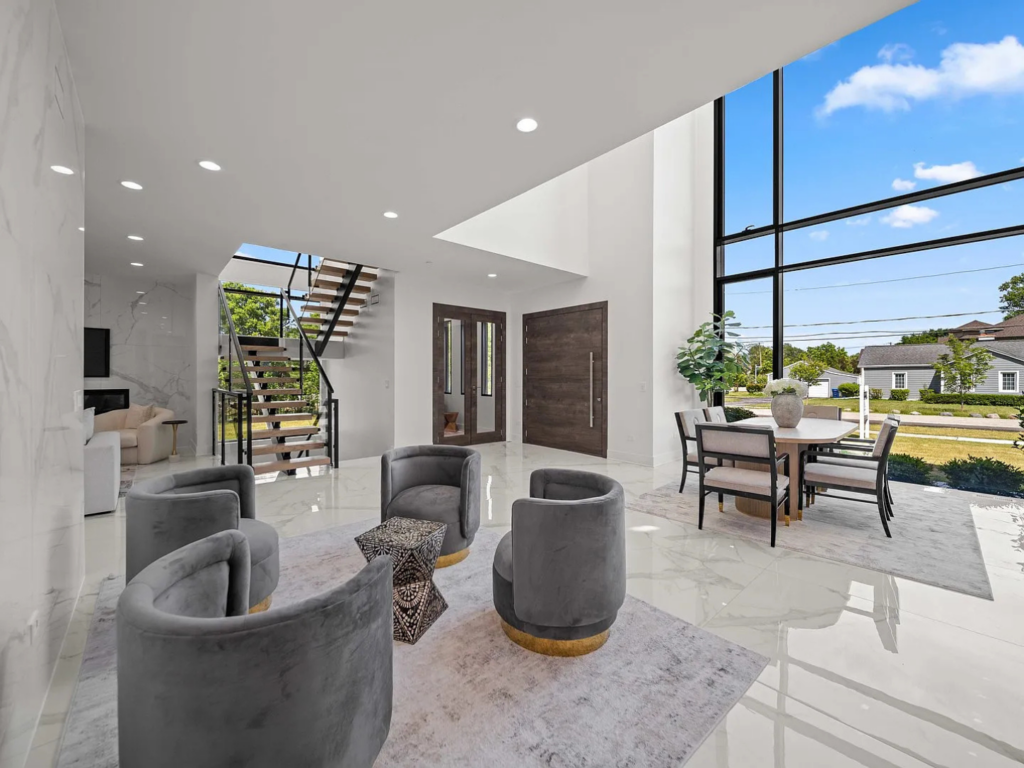
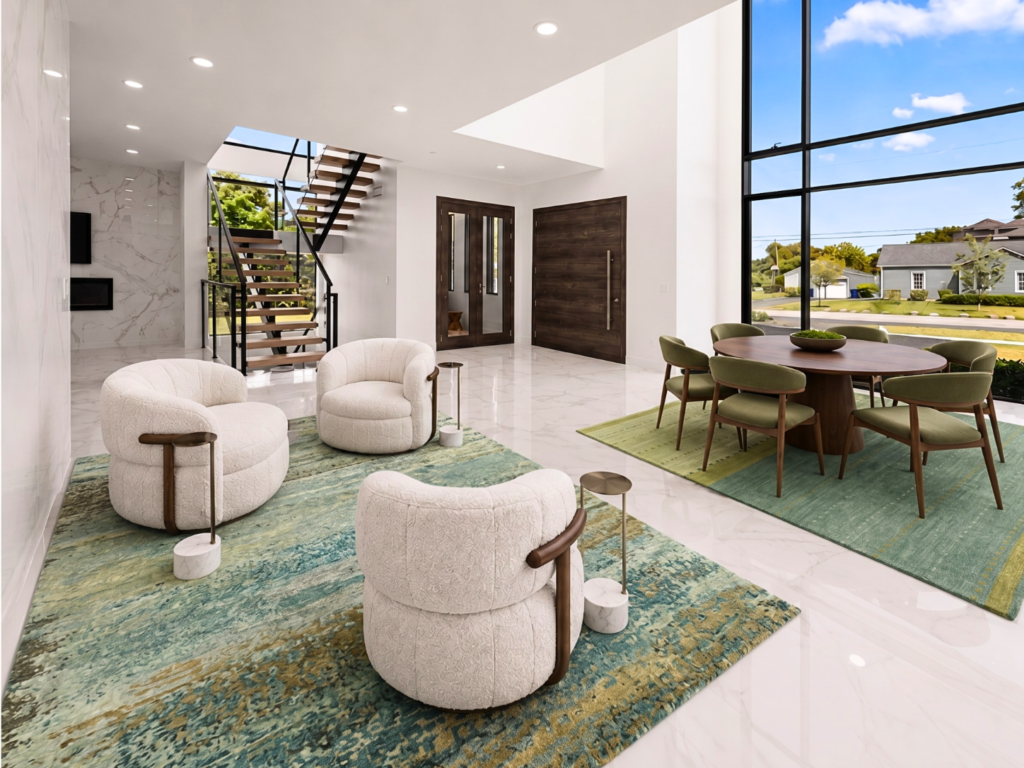
Look at them side by side before reading further. Notice where your eye lands first. Notice where it lands second. Notice whether the space between the staircase and the dining table feels like one continuous room or two rooms that happen to share a floor.
1. Scale
A two-story room demands furniture with enough visual presence to hold its own against the architecture. This isn’t about buying bigger furniture for the sake of size — it’s about proportion. When the ceiling is eighteen feet up and the windows run floor to ceiling, a delicate armchair with thin legs and a low profile doesn’t read as elegant. It reads as lost.
Smaller chairs and tables can feel like they’re floating inside the space rather than defining it. The eye keeps searching for something substantial enough to match the scale of the room, and when it doesn’t find it, the whole space feels unresolved — even if every seat is technically filled. Furniture in a room like this needs weight: deep seats, substantial arms, a silhouette that can be read from thirty feet away, not just up close.
2. Rugs Define Rooms
Large open-concept spaces aren’t one room. They’re several functional rooms sharing one volume — a seating area, a dining area, sometimes a landing zone near the front door — all without walls to separate them. Rugs are what do the work walls would normally do. They establish those rooms.
When rugs are undersized, the seating and dining areas lose definition. Furniture ends up marooned on hard flooring at the edges, and the eye can’t tell where one zone stops and the next begins. A rug that’s sized correctly — large enough that every piece of furniture in the grouping has at least its front legs on it, ideally all four — does more to make a room feel resolved than almost any other single decision. It’s the difference between furniture arranged in a room and furniture just placed on a floor.
3. Color Creates Anchors
In rooms dominated by white walls and glossy floors, neutral furniture can visually disappear. All that brightness and reflection is beautiful, but it’s also relentless — everything competes with the same light, the same shine, the same lack of contrast. Furniture in matching neutral tones gets swallowed by it.
Strategic color and texture help anchor each zone without overwhelming the architecture. This doesn’t mean loud or trendy. It means choosing tones with enough depth — a sage boucle, a walnut base, a rug with movement in it — that the eye has something to land on. Color and texture are what tell the eye “this is where the room happens,” even when the walls around it stay quiet and white.
4. Furnishing Isn’t Decorating
Choosing beautiful furniture isn’t enough. Every piece has to relate to the scale of the room, the surrounding pieces, and the way people actually use the space. A gorgeous chair, on its own, doesn’t guarantee a gorgeous room. What matters is whether that chair is in conversation with everything around it — whether it’s sized correctly for the ceiling height, grounded on a rug that’s sized correctly for the seating group, and given enough color or texture to hold its place against the architecture.
This is the piece that’s easiest to skip and hardest to fix after the fact. You can have excellent individual pieces and still end up with a room that feels disjointed, because good furnishing is a systems decision, not a shopping list.
The Goal Isn’t to Fill a Room
It’s to give every area enough presence that the architecture and the furnishings feel like they belong together.
That’s the difference between a room that photographs well from one angle and a room that actually works — the kind of space that reads as intentional the moment you walk in, whether you’re the one who lives there or the buyer touring it for the first time. Scale, rug sizing, color, and relationship between pieces aren’t decorating flourishes. They’re the structural decisions that determine whether a large room feels finished or just full.
Getting them right the first time is almost always cheaper — in time, in money, in second-guessing — than furnishing by instinct and fixing it later.